

4 min read
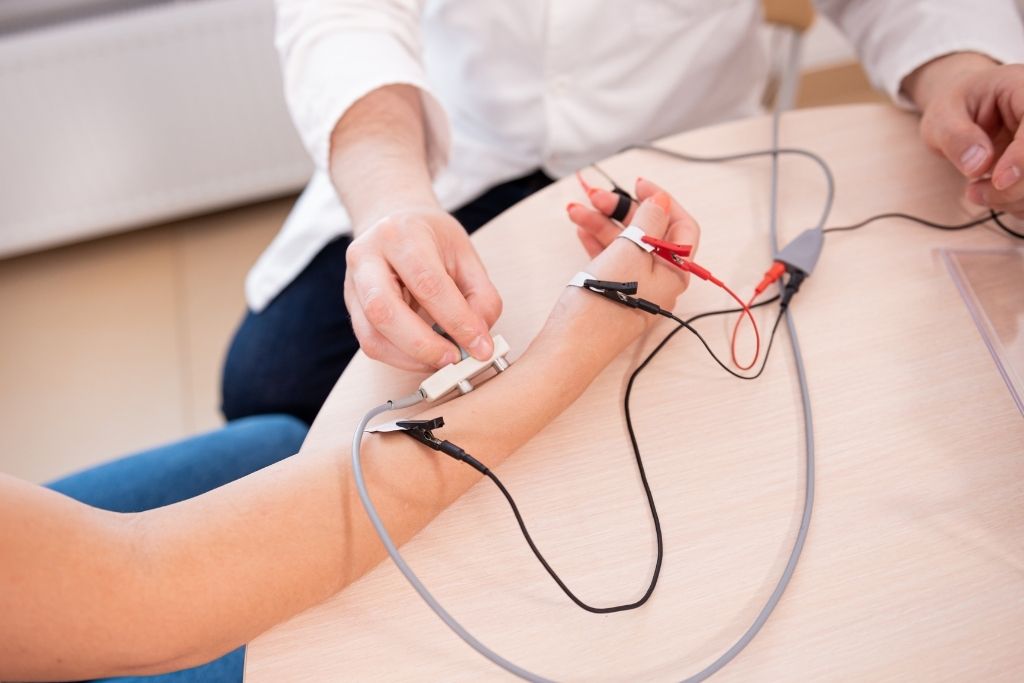
Have you ever had a numb hand that won’t “wake up”… even after you shake it, stretch it, and tell yourself it’s “probably nothing”? Or maybe your foot feels like it’s wearing an invisible sock—tingly, fuzzy, and just not quite right.
Here’s the uncomfortable truth: symptoms like numbness, tingling, pain, or weakness can come from your nerves… or from something else entirely. And when you don’t know which one it is, it’s easy to feel stuck—worried, frustrated, and tired of guessing.
That’s where a nerve conduction test comes in. If you’ve been asking yourself what does a nerve conduction test diagnose, this is one of the best ways to get real clarity. It’s also called a nerve conduction study (NCS, sometimes referred to as NCV). The goal is simple: check how well your peripheral nerves carry electrical signals and spot patterns that can explain what you’re feeling.
So let’s answer the big question—clearly, calmly, and without the confusing fluff.
The Quick Answer: What a Nerve Conduction Test Diagnoses
A nerve conduction test helps evaluate problems with your peripheral nerves (the nerves outside your brain and spinal cord). It’s commonly used to help diagnose peripheral neuropathy and nerve compression syndromes, and it can also help clarify cause, severity, and prognosis.
Why doctors order a nerve conduction study (NCS)
When your nerves are working well, messages travel like a smooth text conversation: fast, clear, and reliable. When something’s off, the “conversation” can slow down, get weaker, or glitch.
Doctors may order an NCS when symptoms suggest a nerve problem—especially if it’s affecting everyday life, like working, sleeping, driving, walking, or even buttoning a shirt.
Common reasons include:
- Numbness or tingling
- Muscle weakness
- Muscle pain
- Muscle cramps or cramping
- Loss of sensation in limbs or extremities
- A feeling like small electric shocks
If you’re reading that list and thinking, “That’s me,” you’re not alone.
What NCS can and can’t diagnose
An NCS is excellent at showing whether a nerve signal is traveling slower or weaker than expected—and where that problem may be happening along a nerve pathway.
But here’s a key point that helps people feel less confused: an NCS doesn’t always give a complete diagnosis by itself. It provides strong clues, then your clinician connects those clues to your symptoms, history, and sometimes other tests.
That’s also why NCS is often done alongside electromyography (EMG)—because together they can help separate a nerve issue from a muscle disorder.
What Will a Nerve Conduction Test Show?
If you’re wondering, “What will a nerve conduction test show?” think of it like a performance check for your nerves—how well they send and receive messages.
A nerve conduction study can show:
- Response time (how fast electrical impulses travel)
- Signal strength (how strongly the nerve responds)
- Nerve sensitivity and overall responsiveness
Electrical signals and response time (how fast impulses travel)
Nerves carry electrical impulses between your brain and the rest of your body. Those signals help you feel sensation and move your muscles.
During an NCS, the test measures the speed of that signal. In healthy nerves, signals can move extremely fast—up to about 120 miles per hour.
If a nerve is damaged or disrupted, the signal may move slower, which can point toward certain types of nerve problems.
Signal strength and nerve sensitivity
Speed isn’t the only thing that matters. The test also measures how “big” or strong the signal is.
A reduced response can suggest that the nerve isn’t transmitting electrical signals effectively. This is often described in terms of the nerve’s responsiveness and sensitivity to stimulation.
And if you’ve ever felt that strange mix of “numb but painful,” this is one reason the test can be so validating: it’s measuring what your body has been trying to communicate.
What abnormal results can suggest
Abnormal results can suggest problems like:
- Nerve damage
- Nerve blocks
- Issues involving myelin (the insulation around nerves), which can affect signal speed
- A more specific “trouble spot” along the nerve pathway
This matters because location changes the plan. A compressed nerve in one area is a very different situation than widespread peripheral nerve involvement.
What Is NCS Test Used to Diagnose? Key Conditions
Now let’s get specific. People search for:
- what is NCS test used to diagnose
- what can a nerve conduction study diagnose
- what does a nerve conduction study show
…and they want a straight answer.
Below is a clear, easy way to see the conditions commonly evaluated with a nerve conduction test.
Quick guide: what a nerve conduction test can help diagnose
| Category | Examples often evaluated with NCS | What the test helps reveal |
| Peripheral nerve problems | Peripheral neuropathy, diabetic neuropathy, chronic inflammatory neuropathy, polyneuropathy, Charcot-Marie-Tooth disease | Whether signals are slowed/weakened, how widespread the issue is, and possible patterns |
| Nerve compression syndromes | Carpal tunnel syndrome, sciatica and other sciatic nerve problems | Whether there’s a “bottleneck” (compression) affecting signal flow in a specific area |
| Nerve & muscle-related conditions | Myopathy, myasthenia gravis | Whether findings point more toward nerve involvement; often clarified further with EMG |
| Other nerve-related evaluations | Bell’s palsy, Guillain-Barré syndrome, herniated disk-related nerve issues | Clues about nerve pathway involvement and how signals are traveling |
Important: A nerve conduction study often supports diagnosis, but results are typically interpreted alongside symptoms, history, and sometimes EMG.
Peripheral neuropathy and nerve damage
Peripheral neuropathy means the peripheral nerves are damaged. A nerve conduction test can help detect the presence and extent of that nerve damage.
One reason neuropathy feels so confusing is that it can show up differently depending on the cause and which nerves are affected. For some people it’s feet first. For others it’s hands. For others it’s patchy or one-sided.
Diabetic neuropathy
Diabetic neuropathy is one of the commonly listed neuropathy types evaluated in nerve conduction testing contexts. If you’ve been managing blood sugar and still feel burning, numbness, tingling, or weakness, your clinician may use NCS to better understand nerve function.
Chronic inflammatory neuropathy / polyneuropathy
A nerve conduction test can help evaluate chronic inflammatory neuropathy and polyneuropathy, both of which involve broader patterns across multiple nerves.
If you’ve felt symptoms spreading—like a ripple effect—this is one reason the test can be valuable: it helps map whether multiple nerve pathways are involved.
Charcot-Marie-Tooth disease
Charcot-Marie-Tooth disease is included among the conditions evaluated with nerve conduction studies. The test can help identify patterns of nerve signaling that fit certain nerve disorders.
Nerve compression syndromes
A nerve compression syndrome happens when pressure is placed on a peripheral nerve. This can cause symptoms that mimic neuropathy, but the treatment approach may differ because the problem is often more localized.
Carpal tunnel syndrome
Carpal tunnel syndrome is one of the most common nerve compression syndromes associated with nerve conduction testing.
If you’ve ever woken up at night with hand numbness, tingling, or pain—then tried to “shake it out”—that story is extremely common with carpal tunnel.
Sciatica and related nerve compression problems
Sciatica and other sciatic nerve problems are also included among conditions evaluated with nerve conduction tests.
Sciatica can feel like a thief—it steals sleep, steals comfort in the car, steals long walks, steals patience. NCS can help clarify whether nerve signaling suggests involvement consistent with nerve compression patterns.
Nerve and muscle disorders sometimes evaluated with NCS
Sometimes the question isn’t only “Is the nerve compressed?” It’s “Is this nerve-related, muscle-related, or both?”
That’s where the NCS + EMG combination can be especially helpful.
Myopathy
Myopathy (a muscle-related condition) appears among the conditions that may be diagnosed or ruled out in the context of nerve conduction studies—especially when paired with EMG.
Myasthenia gravis
Myasthenia gravis is also included among conditions evaluated with nerve conduction testing contexts. Because it involves how nerves and muscles communicate, additional testing alongside NCS may be part of the clinical picture.
Other conditions that may be assessed
Some conditions show up on lists of diagnoses evaluated with nerve conduction studies.
Bell’s palsy
Bell’s palsy is included among the conditions that can be evaluated in nerve conduction testing contexts, especially when clinicians are assessing nerve function and pathways.
Guillain-Barré syndrome
Guillain-Barré syndrome is also included among conditions associated with peripheral nerve testing evaluation contexts.
Symptoms That Often Lead to NCS Testing
If you’ve been telling yourself, “Maybe I’m just overthinking it,” let’s bring this back to real life.
Nerve conduction studies are commonly considered when symptoms suggest nerve signaling issues—especially when they affect quality of life.
Numbness and tingling
Numbness and tingling are big reasons people get referred for NCS—especially in the hands, feet, arms, legs, or face.
Ask yourself:
- Is it worse at night?
- Is it spreading?
- Does it affect one side more than the other?
- Does it flare with certain positions or activities?
Those clues help decide which nerve pathways to test.
Muscle weakness and loss of sensation in limbs
Muscle weakness can feel scary because it often shows up quietly:
- Your grip feels unreliable
- Your hands fatigue faster than they used to
- Your foot feels “heavy” or uncoordinated
- Stairs feel harder than they should
Loss of sensation can also be dangerous in subtle ways—like not noticing temperature changes or small injuries the way you normally would.
Muscle pain, cramps, and “electric” sensations
A nerve conduction test is often associated with symptoms like:
- Muscle pain
- Muscle cramps
- cramping
- “electric shock” sensations
- decreased muscle function
And if you’ve tried to explain nerve symptoms to someone who hasn’t felt them, you know how lonely it can be. Testing gives you something solid to point to—something measurable.
Nerve Conduction Study (NCS) in Miami with Neurology Mobile
If you’re in Miami and looking for real answers, you don’t have to stay stuck in the “maybe” zone—Neurology Mobile offers Nerve Conduction Studies (NCS/NCV) in Miami, to help you understand what your nerves are doing when symptoms like numbness, tingling, pain, cramps, or weakness start taking over your daily life.
Conclusion
In the end, the real value of this test is peace of mind. If you’ve been wondering what does a nerve conduction test diagnose, the answer is that it often helps pinpoint whether your symptoms are tied to a peripheral nerve problem—like nerve damage or nerve compression—and how serious it may be. Instead of living in guesswork, you get measurable clues about how well your nerves are sending signals.
And if you’re still asking what will a nerve conduction test show, think of it as a clear snapshot of nerve function—speed, strength, and consistency—so you and your provider can choose the next step with confidence. Because when your body is sending warning signs, you deserve more than “let’s wait and see”—you deserve answers.
Ready to stop guessing and start getting answers?
If you’re dealing with numbness, tingling, pain, cramps, or weakness, contact Neurology Mobile to schedule a Nerve Conduction Study (NCS/NCV). The sooner you understand what your nerves are doing, the sooner you can take the next step toward feeling like yourself again.
👉 Contact Neurology Mobile in Miami today to schedule your evaluation
Frequently Asked Questions
1) What does a nerve conduction test diagnose most often?
Most often, a nerve conduction test helps diagnose problems involving peripheral nerves, especially peripheral neuropathy and nerve compression syndromes. It can support evaluations for conditions like carpal tunnel syndrome or nerve issues linked with sciatica, and it may help clarify how widespread the problem is and how strongly nerves are signaling.
2) What will a nerve conduction test show if something is wrong?
A nerve conduction test can show signals that are slower or weaker than expected. It measures response time (how fast impulses travel) and signal strength (how well the nerve responds). Abnormal patterns can suggest nerve damage, a nerve block, or issues involving myelin (the nerve’s insulation), depending on how the results look across different nerve pathways.
3) What does a nerve conduction study show compared to an EMG?
A nerve conduction study (NCS/NCV) measures how electrical signals travel along a nerve. An EMG measures electrical activity in a muscle. When done together, they can help your clinician tell whether symptoms like weakness, cramps, or pain are more likely coming from a nerve problem, a muscle problem, or how the two are working together.
4) Is a nerve conduction test painful?
Most people describe it as uncomfortable but tolerable. You may feel a brief, mild electrical pulse—like a quick tap or small jolt. The sensation can be surprising at first, but it usually lasts only a moment. If you’re anxious, tell your provider—small adjustments and clear coaching can make the experience feel much easier.
5) How should I prepare for a nerve conduction test?
Wear comfortable clothing and consider avoiding lotions or oils on your skin that day because electrodes need good contact. Bring a list of your symptoms (where they occur, when they’re worse, what triggers them), since that helps guide which nerve pathways should be tested. If you’re also scheduled for EMG, ask what to expect so you feel fully prepared.